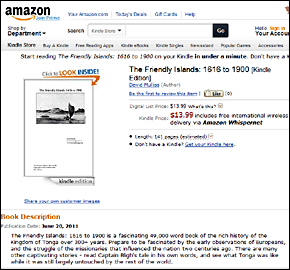

"The Friendly Islands: 1616 to 1900"The Friendly Islands: 1616 to 1900 is a fascinating 49,000 word book of the rich history of the Kingdom of Tonga over 300+ years. Prepare to be fascinated by the early observations of Europeans, and the struggle of the missionaries that influenced the nation two centuries ago. There are many other captivating stories like Captain Bligh's tale in his own words, and see what Tonga was like while it was still largely untouched by the rest of the world. To purchase the ebook of The Friendly Islands scroll to the bottom of this page. A print version is also available - for enquiries please email mail at touchoftonga.com
|
| Chapter Title | Chapter Summary | Excerpt (a short paragraph from the chapter) |
| SCHOUTEN AND LE MAIRE (1616) | The first detailed account of Tonga “The Friendly Islands” was made by the Dutch explorers: Willem Cornelius Schouten and Jacob Le Maire. This can be found in “A General History and Collection of Voyages and Travels, Volume 10 (1874)" by Robert Kerr. | "On the 12th the savages came again in their canoes, laden with coconuts, bananas, ubes-roots, hogs, and fresh water, contending violently who should get first on board. Those who were behind, being unable to get over the throng of canoes and men before them, leapt into the sea, and diving under the canoes..." |
| ABEL TASMAN’S DISCOVERY (1643) | John Pinkerton made an
account of Abel Tasman’s 1643 discovery of Tongatapu and Nomuka
in “Early Australian Voyages” which was published in 1886. |
"We made the whole circuit of the island, which we found well-stocked with cocoa-trees, very regularly planted; we likewise saw abundance of gardens, extremely well laid out, plentifully stocked with all kinds of fruit-trees, all planted in straight lines, and the whole kept in such excellent order, that nothing could have a better effect upon the eye." |
| AN ASTRONOMICAL OBSERVATION (1767) | The Royal Society
proposed that Tongatapu and Nomuka would prove to be ideal locations to
observe an eclipse of the sun by the planet Venus. |
In the latter part of the year 1767, it was resolved by the Royal Society, that it would be proper to send persons into some part of the South Sea to observe a transit of the planet Venus over the sun's disc, which, according to astronomical calculation, would happen in the year 1769; |
| CAPTAIN COOK I – JOURNAL OF FIRST VISIT TO TONGA | The following extract is
adapted from "A General History and Collection of Voyages and Travels,
Volume 14 (1874)" by Robert Kerr. |
I have frequently mentioned a king, which implies the government being in a single person, without knowing for certain whether it is so or no. Such a one was however pointed out to us; and we had no reason to doubt it... |
| CAPTAIN COOK II – COOK’S SECOND VISIT TO TONGA | Arthur Kitson wrote
“The Life of Captain James Cook the Circumnavigator” which
was published in 1907. The book is an excellent account of
Captain Cook’s life and includes an account of his second visit
to Tonga. |
Whilst anchored here, a large sailing canoe arrived, having on board a chief who was treated by the natives with the utmost respect, and the visitors were given to understand that Tattafee Polaho was the king of all the islands. He was invited on board, and brought with him as a present: |
| MISSIONARIES I – THE FIRST MISSIONARIES | A detailed account of the
first missionaries can be found in "The History of the London
Missionary Society, 1795-1895" by Richard Lovett, published in 1899. |
The natives of Tongatapu were a fine race physically, but cruel and treacherous, and even more given to thieving than those on Tahiti. They took umbrage at the prayers of the missionaries, and attributed various misfortunes by which they were visited at this practice. |
| MISSIONARIES II – THE BEGINNING (1822) | A narrative of mission
work in the South Pacific was made by James McKinney Alexander, and
published by the American Tract Society in “The Islands of the
Pacific” in 1895. |
Continuing the narrative
of mission work in Tonga, we now pass to those of the Wesleyan Society
in the Tonga and Fiji Islands. It is interesting and most
important to note that no less efficient labour was performed, and
divine blessing enjoyed, by the agents of the latter society than by
those of the former. |
| MISSIONARIES III – JOHN THOMAS (1826) | The Friendly Islands had been discovered by Captain Cook, who had made the mistake of giving this island group its name. Closer acquaintance had made clear the fact that the English language could hardly have furnished a more unsuitable adjective... | In 1826, a good missionary named John Thomas had gone to Tonga, and now he and his company and the new band worked on together. There were still many hardships and trials to endure before there was much encouragement. |
| MISSIONARIES IV – JOHN WILLIAMS VISITS TONGA (1832) | In 1816, John Williams
became an English Missionary from the London Missionary Society.
The next year he travelled with his wife to Tahiti. Mr. Williams
visited Tongatapu on the 22nd of November 1832 on board the Messenger
of Peace. |
As soon as we landed, the
king, Tupou, sent a messenger to invite Makea to his house. There
he was received in true Tonga style, and in a manner befitting his
rank. Having reached Tupou’s residence, he was requested to
seat himself by the king’s side, who was attended by two
matapules, or orators. |
| MISSIONARIES V – WESLEYAN METHODIST CHURCH (1900) | The Methodist Episcopal
Church Missionary Society published “The Gospel in All
Lands” in 1903 giving great detail about the Wesleyan Methodists
in Tonga at this time. |
"...the commander of a
British warship that had been cruising in the Pacific went to the
Friendly Islands. When he saw King George come alongside in his
royal canoe, and in the dress of a British Officer, he said, “He
is every inch a king; give him a twenty-one gun salute!” |
| MUTINY ON THE BOUNTY – IN BLIGH’S WORDS (1789) | About the year 1786, the
planters and merchants interested in the West Indies became anxious to
introduce an exceedingly valuable plant, the breadfruit tree.... |
Thus far the voyage had advanced in a course of uninterrupted prosperity, and had been attended with many circumstances equally pleasing and satisfactory. A very different scene was now to be experienced. A conspiracy had been formed which was to render all our past labour productive only of extreme misery and distress. |
| THE KINGDOM OF TONGA I – A VISIT FROM HMS CHALLENGER (1874) | William James Joseph Spry wrote an interesting account of Tonga in “The Cruise of Her Majesty's Ship The ‘Challenger.’” (1877) He describes Nuku`alofa, the King and Queen (George Tupou I and his wife Charlotte), the manufacture of tapa, and more, only a year before the Constitution was passed on 4 November 1875. | The dress of both sexes is made of similar material, but is differently arranged. The fabric (tapa) is made from the bark of a tree extensively cultivated throughout the islands, and is beaten out with a wooden mallet about a foot long and two or three inches thick. |
| THE KINGDOM OF TONGA II – A VISIT FROM HMS CHALLENGER | George Granville Campbell
was the author of “Log-letters from The Challenger" which was
published by Macmillan in 1877, which offers a slightly different
account of the visit of this famous vessel. |
The huts are oval in
shape, the boat shaped roofs supported by stout posts, the walls made
of reeds interlaced in patterns, the roofs thickly thatched with
bundles of wild sugarcane, on which, again, coconut fronds are spread;
and over the low door falls a mat, with which, too, the floors are
carpeted. |
| THE KINGDOM OF TONGA III – TONGATAPU AND NIUAFO`OU IN 1879 | Hugh Hastings
Romilly’s observations of Tongatapu and Niuafo`ou in 1879 were
originally published in “The Western Pacific and New Guinea:
Notes on the Natives, Christian and Cannibal”. |
The natives of some
islands are adopting European habits, especially in the matter of
clothes. In Tongatapu, in which the island capital of Tonga is
situated, you may see the locals playing cricket – and very well
they play too. |
| THE KINGDOM OF TONGA IV – A ROYAL IMPRESSION (circa 1885) | Gilbert Parker wrote
“An Amiable Revenge” in 1890, which was originally
published in “Cumner’s Son and other Sea Folk.”
The German steamer Lubeck worked its way around Fiji, Tonga and
Samoa. This account relates an account from the mid to late 1880s. |
Whenever any one says to
me that civilisation is a failure, I refer him to certain records of
Tonga, and tell him the story of an amiable revenge. He is invariably
convinced that savages can learn easily the forms of convention and the
arts of government--and other things. |
| THE KINGDOM OF TONGA V - TREATY WITH THE U.S.A (1886) | In 1886, the United
States and the Kingdom of Tonga signed a treaty of “Amity,
Commerce and Navigation” on board the U.S. Steamer the
“Mohican.” |
Concluded October 2, 1886;
ratification advised by the Senate, with amendment, January 19, 1888;
ratified by the President February 7, 1888; ratifications exchanged
August 1, 1888; proclaimed September 18, 1888. (Treaties and
Conventions, 1889, p.1205) |
| THE KINGDOM OF TONGA VI – AMONG THE PACIFIC ISLANDS (1888) | The Littell’s
Living Age Co. covered several of the Pacific Islands in its magazine
"The Living Age." This feature on Tonga provides a detailed
description of Tonga at that time, including the trilithon,
Christianity, politics, government structure, Mr. Baker’s
character, and Niuafo`ou. |
The
Tongans, a wonderfully energetic people, occupied Samoa, probably some
centuries ago; the remains of their roads and fortifications still
exist there; and their king, in Captain Cook’s time, considered
Samoa to be within his dominions. |
| TONGA I – FRIENDLY ISLANDS NOT SO FRIENDLY | "An Account of the
Natives of the Tonga Islands in the South Pacific Ocean" by John Martin
MD, was originally published in 1817, and documents a planned attack on
Captain Cook. |
When Captain Cook named
Tonga (initially it was only the Ha`apai group) the “Friendly
Islands”, he was apparently unaware of the conspiracy to steal
his vessels and murder the crew. Yet today, one can see that
Cook’s title was inadvertently prophetic, for today, visitors are
charmed by an amazing outgoing friendliness. |
| TONGA II – CHIEF FINAU’S VIEW OF WRITING | The profound regard for
the art of writing is illustrated by an incident reported by William
Mariner in his “Account of the Natives of the Tonga
Islands.” |
Finau, the head chief,
having intercepted a letter written by Mr. Mariner to any captain who
might touch at Tonga to rescue him, “at length sent for Mr.
Mariner and desired him to write down something. |
| TONGA III – WERE THE TONGANS CIVILISED? | Mariner, who lived among
the Tongans four years, and whose adventures and observations were
afterward recorded by Martin, gives information which indicates that
Cook was wrong when he said that a more civilized people does not exist
under the sun. |
When a woman is taken prisoner (in war) she generally has to submit; but this is a thing of course, and considered neither an outrage nor dishonour; the only dishonour being to be a prisoner and consequently a sort of servant to the conqueror. |
| TONGA IV – POEMS OF TONGA | Two poems of Tonga from unusual and interesting sources. | Let us plait the garland,
and weave the staves, While the wild waves dance on our iron stand; Tomorrow these waves may wash our graves, And the moon looks down on a ruined land. |
Copyright (C) David Mulliss 2009